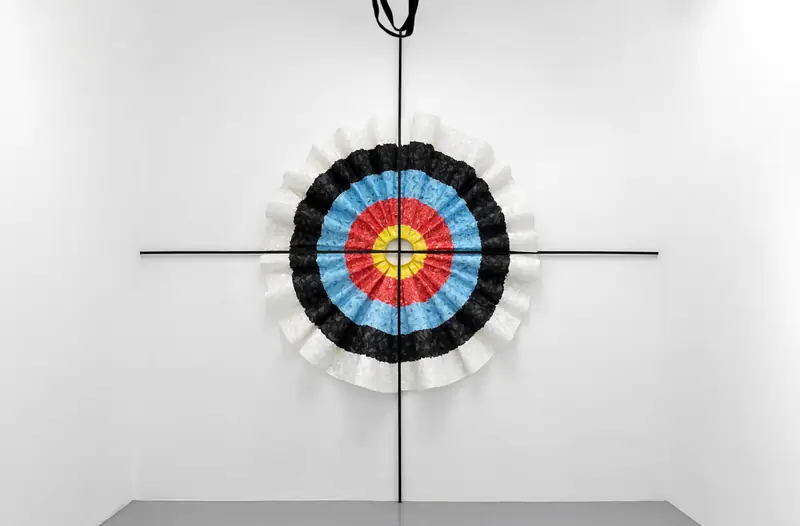
Galería Ruth Benzacar traces its origins to 1965, when Ruth Benzacar began hosting artists and critics in her Buenos Aires home, creating what she called a casa-galería — a domestic space where bi-weekly gatherings around artworks formed the first infrastructure of a serious commercial programme. Her international instincts were immediately apparent: within a year she had taken a film about Argentine artists to New York, screening it at MoMA as an early act of cross-hemispheric positioning. Over the following decades, the gallery moved through several professional spaces, most famously the Florida 1000 address beneath Plaza San Martín, which became the de facto headquarters of Argentina's conceptual art generation and a precursor to the institutional structures that would later coalesce around arteBA.
Since 2015 the gallery has operated from a 650-square-metre industrial space in Villa Crespo, the relocated address formalising a shift that had already occurred programmatically — from the populist energy of the pedestrian strip to a more architecturally demanding environment suited to the scale of artists like Adrián Villar Rojas, whose towering material accumulations require room to breathe. The current programme, shaped by Mora Bacal, who joined as co-director in 2009 after her mother Ruth passed in 2000 and her sister Orly's decade of leadership, represents more than thirty artists across generations: Liliana Porter's photographic fictions of miniature worlds, Jorge Macchi's quietly catastrophic drawings and installations, Leandro Erlich's perceptual architecture that has toured internationally, and Tomás Saraceno, whose cosmic inflatables the gallery supported in his formative years.
Few galleries on the continent can claim a comparable depth of institutional connection — Ruth Benzacar's history is inseparable from the story of how Argentine Conceptualism found its commercial footing — and the current programme sustains that authority without retreating into it.