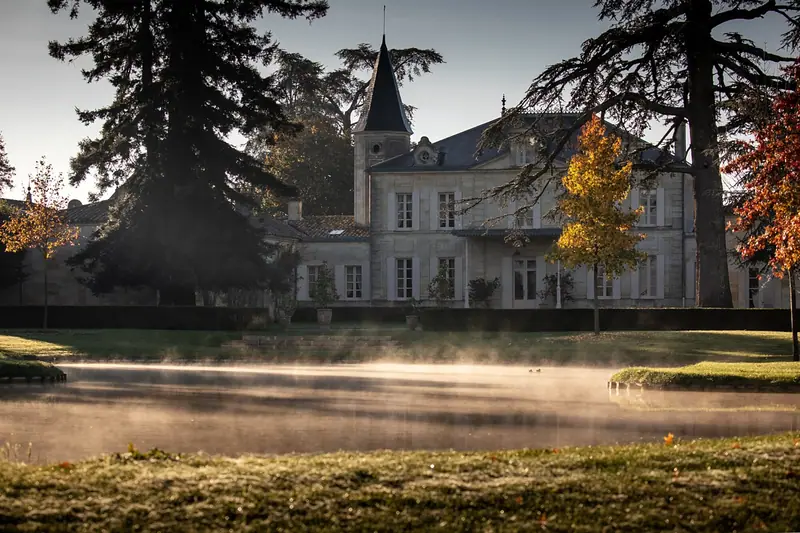
Château Cheval Blanc is a wine estate in Saint-Émilion, in the Bordeaux region of France. Its history under that name begins in 1832, when Jean-Jacques Ducasse bought the heart of the domain. The estate makes red wine mainly from Cabernet Franc, a variety not usually found on the Right Bank.
Cabernet Franc dominates the vineyard, with some Merlot and Cabernet Sauvignon, across plots of clay, gravel and sand. The estate stands on quaternary alluvium from the Isle, where most well-known Saint-Émilion growths stand on limestone, and its non-calcareous soils resemble those of Pomerol. Each plot is vinified separately before the vintage is blended.
Alongside Château Cheval Blanc, the estate makes Le Petit Cheval, a white wine from Château La Tour du Pin, a grand cru planted with Merlot and Cabernet Franc. There, Sauvignon Blanc was grafted to test the soil for white grapes, and Sémillon was found in a vineyard already in production. Château Quinault L'Enclos and Cheval des Andes complete the family of wines.
The domain follows agroforestry: vines share the land with animals, vegetable gardens, orchards, flower gardens and beehives, on unploughed living soils under vegetative ground cover. The estate also produces a podcast, Another kind of agriculture, about farmers who practise agroecology across France.
After Ducasse bought the core of the domain, plots acquired from Château Figeac formed its vineyard. His daughter Henriette Ducasse married Jean Laussac-Fourcaud, who laid covered drains on chosen plots and replanted part of the property with half Merlot and half Cabernet Franc, finished in 1871. The bronze medal won at the London Universal Exhibition in 1862 still appears on the labels, and in 1998 Bernard Arnault and Albert Frère bought the estate.