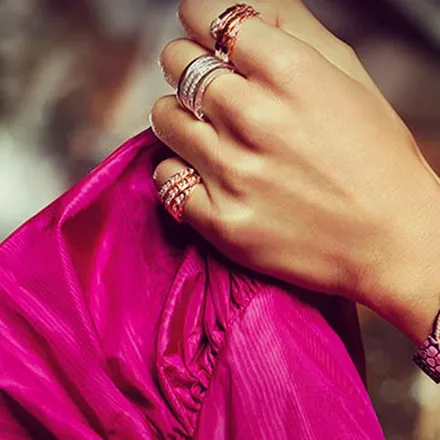
Bulgari is a high jewellery house based in Rome, founded in 1884 by the Greek silversmith Sotirio Bulgari, who began by making silver ornaments. Its work is built on large coloured gemstones, gold and a Roman design vocabulary. The house also makes watches that carry the same motifs.
In the 1940s the brothers Giorgio and Costantino took over the family business and moved it away from its delicate Parisian traditions towards bold coloured gemstones and new design techniques. By the 1950s the house had settled on contrasting rubies, sapphires, emeralds and diamonds in large pieces, with cabochon-cut stones and motifs taken from Rome.
Serpenti, a coiled snake motif that first appeared in the 1940s, began as bracelets and watches inspired by Art Deco. The snake's body uses the Tubogas construction, whose name comes from its resemblance to coiled gas pipes, and the flexible form wraps tightly around the wrist or neck before diamonds and gemstones are added to it.
Tubogas is a system of interlocking gold bands that makes a coiled form without visible soldering, which lets bracelets and watches move around the wrist while keeping their strength. The Monete pieces set ancient coins in gold bezels, including Tubogas bracelets that carry a coin of the Roman emperor Augustus.
Cabochon cutting gives a stone a smooth, domed surface with no facets, a cut the house uses on semi-transparent gemstones to bring out their colour. Its necklaces, bracelets, watches and rings are built around large natural stones. Lucia Silvestri is creative director, and the design team returns to Serpenti, Tubogas and Monete for new combinations of gemstones.