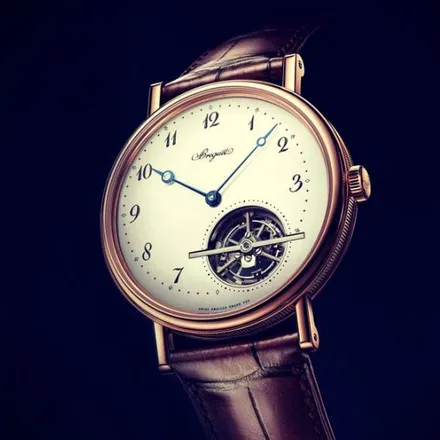
Breguet is a Swiss watchmaking house based in Le Locle, Switzerland, and founded in Paris in 1775 by Abraham-Louis Breguet. It makes watches and complications across seven collections, among them Classique, Marine, Tradition and Type XX.
Abraham-Louis Breguet left his native Neuchâtel in his teens to finish his apprenticeship in Versailles and Paris, then opened his own workshop on the Île de la Cité. He received a patent for the Tourbillon regulator in 1801 and became Watchmaker to the French Royal Navy in 1815. The business passed to his son Antoine-Louis Breguet and then to his grandson Louis-Clément Breguet, and in 1999 the watchmaking group was sold to Swatch Group.
His inventions include the pare-chute shock absorber, the gong-spring and the use of guilloché in watchmaking. Watch N°160 was ordered by one of Marie-Antoinette's guards with every complication and improvement then known. The tact watch carries an arrow on its case that reproduces the hour hand, so the wearer reads the time by touch. Purchases by Caroline Murat, Queen of Naples, led to a watch designed to be worn on the wrist.
Guillochage, engraving, anglage and métiers d'art are practised within the Manufacture, which works in the Vallée de Joux at L'Abbaye and L'Orient. Breguet gold is an 18K alloy developed by the house, with a warm, subtly rosy hue. Platinum is machined and finished with particular mastery, and titanium, light and little affected by magnetism, goes into movement components and cases.
The house keeps records of its timepieces, commissions, sales and owners at Place Vendôme in Paris, and the Breguet Museum examines historical watches bearing the Breguet signature to confirm their authenticity.