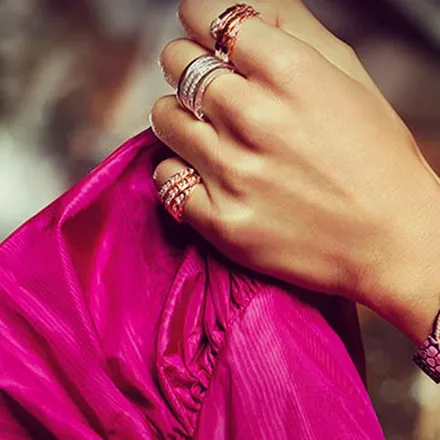
Bulgari is a Swiss watch and jewellery manufacture based in Neuchâtel, founded in Rome in 1884 by the Greek silversmith Sotirios Voulgaris. Its watches bring a Roman jeweller's feeling for gold, gemstones and bold shapes to Swiss mechanical movements.
Voulgaris opened his first shop on Via Sistina, trading silver objects, antiques and jewels, and later Italianised his name to Sotirio Bulgari. His sons moved the firm toward high jewellery in platinum and diamonds, and the first known wristwatches were jewelled Art Deco pieces.
Snake watches coil gold around the wrist and end in a jewelled head that hides the dial, a form the Serpenti collection continues. The Tubogas bracelet wraps bands of gold or steel around a steel core. The Bulgari Bulgari of 1977 has a cylindrical case with the house name engraved on the bezel, and the Diagono sport line keeps that engraving. The Lucea for women has a round case and a cabochon-cut stone on the crown.
Bulgari Time was set up in Neuchâtel in 1982 to bring watchmaking under the house's control. The house bought Daniel Roth and Gérald Genta with their workshops in Le Sentier, and took stakes in Swiss makers of dials, straps and cases. It designs, develops and produces the essential parts of its watches itself, from casting gold alloys to machining, assembling and finishing movement, case, dial and bracelet.
The octagonal Octo case, used earlier for some Gérald Genta complications, was restyled into a line of three-hand watches and, two years later, chronographs. The Octo Finissimo Tourbillon of 2014 has a 40 mm platinum case 5 mm thick around a hand-wound movement of 1.95 mm, made thin by omitting a regulator assembly and timing the balance wheel directly.