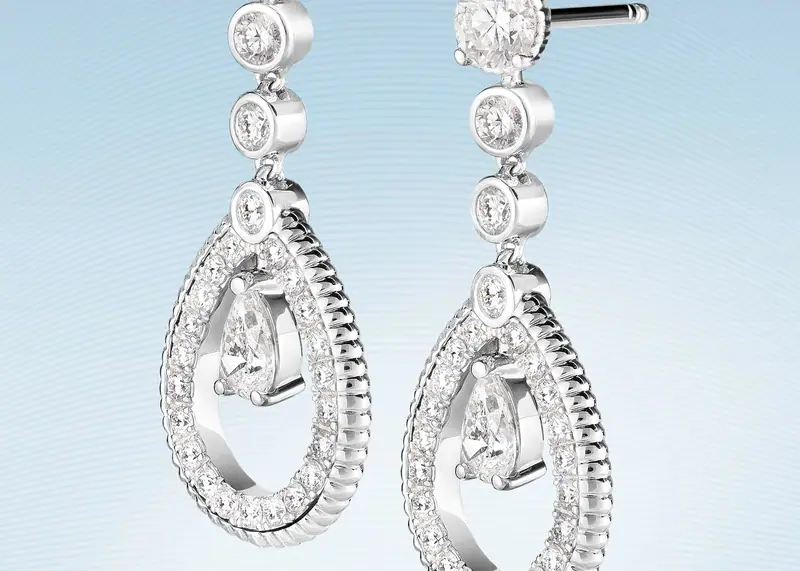
Fabergé is a jewellery and watch house based in London. Gustav Fabergé founded it in 1842, when he opened a small workshop and jewellery shop on Bolshaya Morskaya Street in St Petersburg. It makes fine jewellery, high jewellery, egg objets and watches.
In 1872 his elder son, Peter Carl Fabergé, took over the business, having trained with jewellers in Germany, France and Britain and repaired historic jewels in the Treasury Gallery of the Imperial Hermitage. His younger brother Agathon later joined the family firm from Dresden.
In 1885 Emperor Alexander III commissioned a jewelled Easter egg for the Empress: a gold egg covered in enamel, holding a golden hen, a diamond-set crown and a small ruby pendant egg. The house went on to make fifty Imperial Easter eggs, each with its own design, for Alexander III and his son Nicholas II. In 1900 the St Petersburg headquarters moved to a purpose-built neo-Gothic building at 24 Bolshaya Morskaya Street, clad in Karelian granite, which held the workshops, an art studio and the offices.
Fabergé Heritage turns the egg silhouette into surprise pendants, rings, earrings and bracelets in 18k yellow, white and rose gold, using guilloché enamelling for the surprise. Fabergé №1 reduces the egg pendant to a minimal form in 18k yellow gold with round diamonds and enamel, and draws on the egg given to Empress Maria Feodorovna in 1885.
The watch collections are Compliquée and Visionnaire, with automatic, manual winding and chronograph watches in the range, some set with gemstones. Workmasters carry out the enamelling, a technique revived under Carl Fabergé and used on decorative objects alongside coloured semi-precious stones.