Carpet Society is a Paris-based house of carpets, rugs and decorative flooring, founded in 1955. It groups makers from France and Belgium and works with designers, interior architects, decorators and private clients on hotels, retail spaces, residences and yachts.
Every project starts with a discussion, and an online configurator lets clients choose a pattern, colours and a manufacturing technique, then see the result in a virtual room or in a photograph of their own interior. The techniques run from Wilton and Axminster weaving to hand tufting and hand-knotted Tibetan or Persian rugs.
Manufacture Royale d'Aubusson, founded in 1751, weaves rugs, staircase carpets and made-to-measure carpets, and is the last French manufacturer to use the Wilton technique. Jules Flipo, created in 1867, keeps to Wilton weaving and adapts designs from its archive. Louis De Poortere began in 1929 in Mouscron, Belgium, and still makes Wilton rugs and carpets there.
Ora Pro Nobis makes hand-tufted rugs in workshops at Stekene, Belgium, from wool, linen, tencel and bamboo, and holds the Handmade in Belgium label. Its production system makes a rug in a single piece up to 450 cm wide. Codimat Collection, the house founded in 1955, makes made-to-measure floors and has supplied the Château de Fontainebleau and the Académie Française.
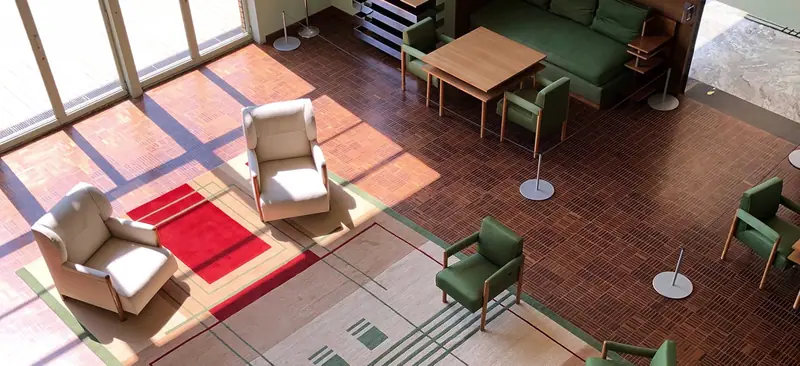
At the Institut de France in Paris, it designed olive leaf motifs and made rugs and carpets in Drap de France blue, a reference to the clothes academicians wear. At Villa Cavrois in Croix, it recreated three carpets by the architect Robert Mallet-Stevens, hand-knotted from old black and white photographs and his plans. Its archive holds drawings by Madeleine Castaing, David Hicks and Jean-Pierre Garraud.