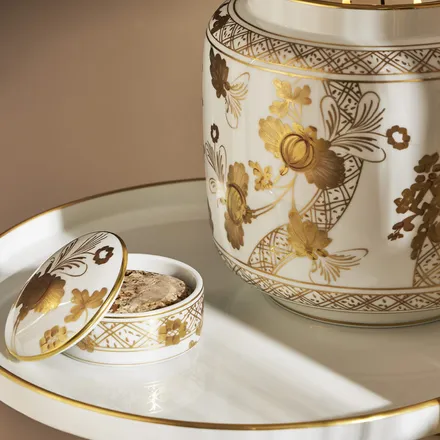
Ginori 1735 is an Italian maker of hard porcelain tableware and home objects, based in Sesto Fiorentino. The house dates from 1735, when Marchese Carlo Andrea Ginori began the Manifattura di Doccia in the villa of his family estate at Doccia.
The porcelain is a mix of kaolin at 50%, feldspar at 25% and quartz at 25%. Artisans pour it into plaster moulds, which absorb water from the mix and leave a solid layer on the walls. The raw piece is opened and finished by hand with handles, knobs and spouts.
A biscuit firing at 1000°C hardens the clay, the piece is dipped in a glaze of water and quartz, and a second firing at 1400°C vitrifies it into a white, translucent surface. Each piece takes 6 to 8 hours of work and more than 8 days to finish. Decoration uses decals, gilding in pure gold, bright gold and platinum, hand airbrushing, and brush painting in the spolvero technique, which transfers a drawing as in fresco.
Designers draw the concepts for each collection, sculptors turn them into plaster moulds, and the Voltone Archive keeps the original moulds of every object made at the Manifattura since 1735. Il Viaggio di Nettuno puts mythological creatures on plates, cups and trays. Ginori Domus extends the house into furniture, textiles, lighting, fragrances, crystal and cutlery, made with Rubelli for textiles and Barovier & Toso for crystal.
Gio Ponti directed the house's art from 1923, and Giovanni Gariboldi, who began as his apprentice modeller, later took the same post. The Colonna service, built around minimal bulk and practicality, won the Compasso d'Oro in 1954. Gucci acquired the Manifattura in 2013, bringing it into Kering.