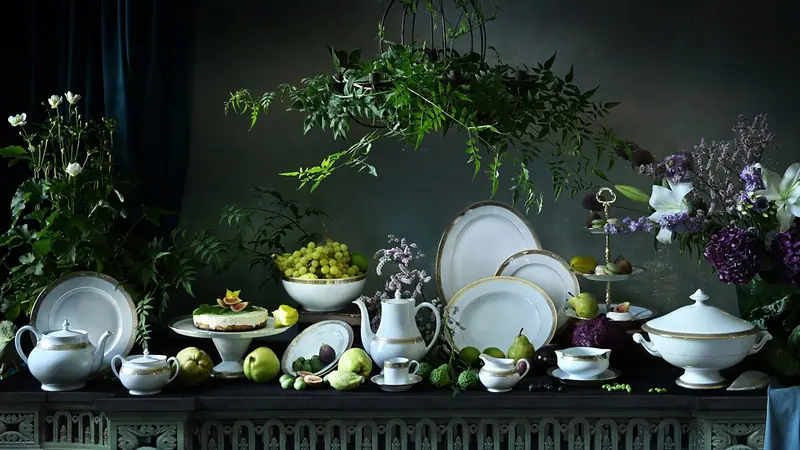
Haviland is a French porcelain house based in Limoges, founded in 1842 by the American importer David Haviland. It makes tableware and decorative objects in Limoges porcelain, among them dinner plates, tea services, vases, trays and candy boxes.
David Haviland traded in earthenware and porcelain from New York before he settled in Limoges to open his own manufacture, close to the kaolin deposits of Saint-Yrieix-la-Perche. He chose to control every step from paste to decoration, developed the hand-painting technique called enluminage, and brought in kilns able to fire large batches of plates at once. In 1872 the house opened an artists' studio in Auteuil under the engraver Félix Bracquemond, and in 1992 the manufacture moved into a modern factory in Limoges.
The collections fall into three movements: Classicism and Neoclassicism, Orientalism and Exoticism, and Modernism and Abstraction. Dammouse draws on Japanese prints and silks, with floral motifs touched with gold in the spirit of the Auteuil studio, and covers a tumbler that doubles as a small vase or pencil holder, trays and candy boxes. Rêves du Nil brings papyrus, lotus flowers and palmettes together in the colours of the Nile, composed by the Haviland studio and applied to candy boxes, tumblers and vases.
Antoine Bourdelle, a student of Auguste Rodin, began reinterpreting porcelain for the house in 1900. Suzanne Lalique and Jean Luce designed Art Deco pieces, Luce with gold lines and geometric motifs.
Marthe Ritz Paris is a collection made for the Ritz Paris, and it includes a soup tureen. The house has also equipped the carriages of the Orient Express.