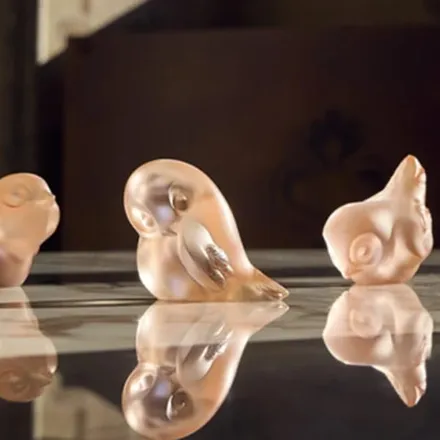
Lalique is a French crystal house based in Paris, with a range that spans decorative objects, tableware, jewellery, perfumes, lighting and interior design. It traces its founding to 1888, when René Lalique designed his first gold parures inspired by Antiquity and Japonism.
The crystal is made at the glassworks in Wingen-sur-Moder in Alsace, where the first furnace was lit in 1922. Designers work from flora, fauna and the female form, themes taken from René Lalique, and a single piece can take up to 40 steps. Glassmakers gather, clean, shape and reheat the crystal in the hot glass workshops, then diamond-tipped saws cut it under water in the cold glass workshop. Each piece is checked for defects and then signed by hand.
Certain works are cast by lost wax: a wax model is encased in refractory plaster and fired so the wax melts, and molten crystal is poured into the hollow. The plaster keeps the imprint, so several castings can follow from one model. Lalique Art uses the method with contemporary artists such as Zaha Hadid and Damien Hirst, and its first piece was Victoire de Samothrace, made with the Yves Klein Archives.
Cabochon is a jewellery collection of rings, pendants and a leather bracelet. The Bacchantes vase and the Fish sculpture are among the decorative pieces, 100 Points is a tableware collection, and Alizé is a lighting collection.
René Lalique began as a jeweller, combining gold and gemstones with mother-of-pearl, horn, enamel and glass. From 1907 he designed for the perfume maker François Coty and moved increasingly into industrial glass production. In 2008 a Swiss group under the management of Silvio Denz acquired the house.