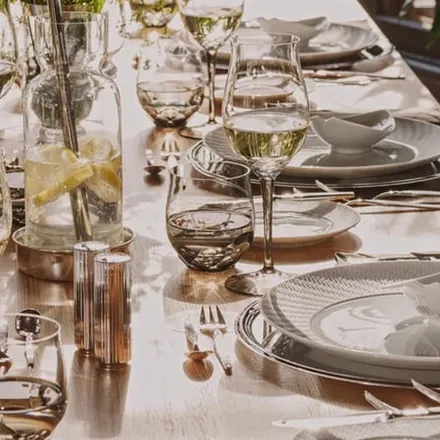
Meissen is a porcelain manufactory in Meissen, Germany, that makes tableware, figures, fine art pieces, jewellery and home decoration. Augustus the Strong, Elector of Saxony, founded it in 1710, and it makes its porcelain at a single site in the Triebisch valley.
The work begins in the manufactory's own mine near the town, where kaolin is dug. The white clay is combined by hand with local feldspar and quartz into the raw porcelain body. Every piece is formed by turning, casting or moulding, and plates and cups are shaped by hand on turntables. A colour laboratory develops new porcelain colours, and its recipes let the workshop reproduce each shade.
Each piece starts from the mould archive, a store of plaster moulds, historic models and templates from which nearly every form the manufactory has made can be reproduced. Painters and modellers are trained within the house, and a piece from the Limited Masterpieces collection takes months of handwork to complete.
Court alchemist Johann Friedrich Böttger developed the European hard porcelain, and production began in the Albrechtsburg castle in Meissen. Crossed swords, taken from the Saxon coat of arms, were introduced in 1722 to mark authentic pieces. The workshops moved to the Triebisch valley in the early 1860s.
The Swan Service, commissioned in 1737 by Heinrich Graf von Brühl, was conceived for one hundred people and comprises more than 2,200 pieces, with swans appearing in relief, as figures and as vessels. The Onion Pattern, which shows peach, pomegranate and citrus fruit, sits beside Form N° 41, whose Mystic Maison decor of fabulous creatures, rocaille and shells is made by the Meissen Atelier.