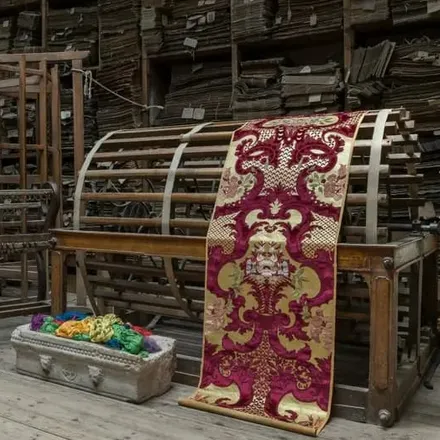
Tessitura Luigi Bevilacqua is a silk weaving house in Venice, founded in 1875 by Luigi Bevilacqua. It weaves velvets, damasks, lampas and brocades for interiors and fashion, and makes soprarizzo velvet by hand.
Soprarizzo velvet is woven by hand on 18 looms from the eighteenth century, which come from the Silk School of the Republic of Venice. The weavers work with techniques handed down over centuries, and the cloth is slow work, done by experienced hands. A mechanical production was later added beside the hand weaving, working from the house's own designs. Cloth from both goes into private residences, into the restoration of palaces and old buildings, and into haute couture garments.
The velvet range is divided into multicolour, animal-pattern, rod and hand-made types. Alongside it the house weaves broccatelles, lampas, damasks and coordinated cloths, and it produces wallpaper. Its accessories are bags, cushions, scarves and folding screens.
Its velvets and brocades have dressed palaces, churches and theatres, from the Basilica della Salute in Venice to the residential palace in Dresden. A designer conceived the fabrics woven for Stockholm City Hall, and the fashion house Roberta di Camerino turned the velvets into its Bagonghi bags.
The family name appears in Venetian weaving in 1499, when a small scroll in the painting San Marco trascinato nella sinagoga names Giacomo Bevilacqua, weaver, as one of the patrons. The founder reused old looms of the Silk School of the Serenissima. His sons and descendants have kept the craft in the family, and Rodolfo Bevilacqua is president and responsible for production.