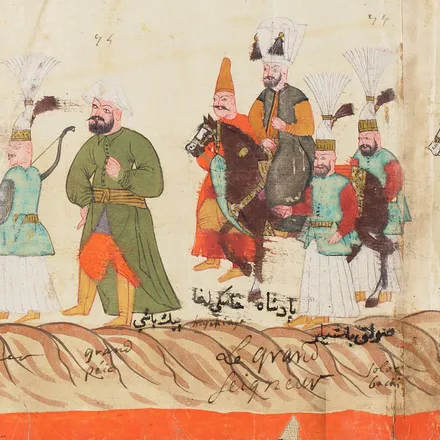
The V&A gathers sixteen centuries of Byzantine and Ottoman art from one city at V&A South Kensington from Saturday 7 November 2026. The exhibition, Constantinople to Istanbul: One City, Two Empires, fills Galleries 38 and 39.
In brief
Saturday 7 November 2026
 London, United Kingdom
- Venue
- V&A South Kensington
- Category
- Exhibition
- Website
- vam.ac.uk
Constantine made the city the eastern seat of Rome in 330. It became the centre of Byzantine Christianity, was sacked by crusaders, and fell to Mehmed II in 1453. It was then the Ottoman capital until 1922.
The V&A argues that the city’s art is continuous rather than interrupted. In its account, the craftsmen did not stop working in 1453, and the Ottoman objects carry the Byzantine ones inside them.
The museum’s Islamic and Byzantine holdings have historically sat in different departments and galleries. The exhibition argues against that division, and shows these objects together in the UK for the first time.
Among them are a tenth-century Byzantine ivory casket carrying pagan scenes, an eleventh-century enkolpion and a Pisanello medal of Emperor John VIII Palaiologos. An Ottoman processional scroll and an eighteenth-century long-necked tambur follow.
It is the first of five exhibitions the museum has announced across its South Kensington and Stratford sites.