Kempinski’s Prague Pivot Starts in a Monastery
A monastery hotel in Malá Strana becomes the clearest expression yet of Kempinski’s heritage-led, asset-heavy next chapter.
Kempinski’s acquisition of the Augustine Hotel, Prague, gives one of the city’s most atmospheric addresses a new role in the group’s evolution. Set within the Augustinian Monastery of St. Thomas, the 101-room property has long traded on a rare mix of contemplative history, ceremonial architecture and discreet five-star polish for an international clientele.
In Malá Strana, beneath Prague Castle and moments from Charles Bridge, the hotel occupies a section of a still-active monastic complex with roots stretching back eight centuries. Under Kempinski, the property will remain a white-label luxury hotel until late 2026, when it is expected to re-emerge as a flagship expression of the brand’s future direction.
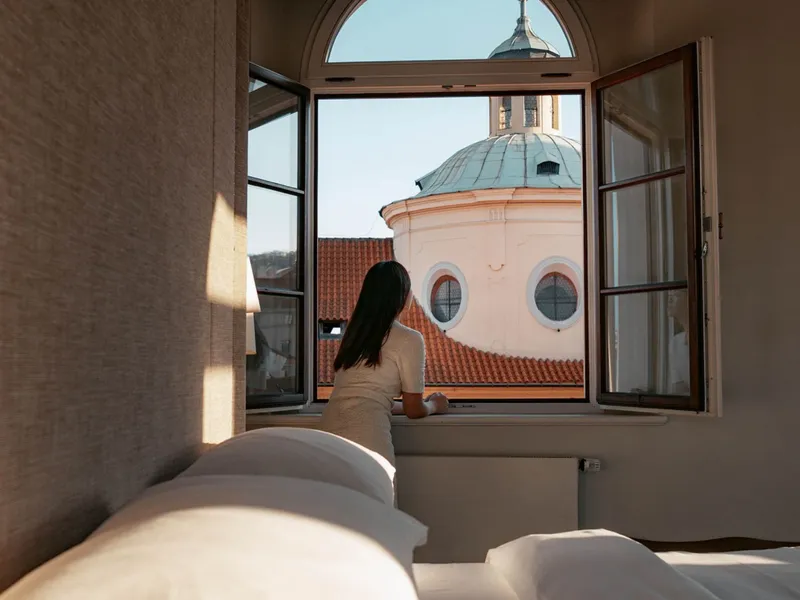
What makes Augustine distinct is the way its fabric resists standardisation. Guest rooms and suites preserve original vaulted ceilings, timber beams and the proportions of the monks’ former quarters, while public spaces move between cloister calm and city-hotel ease. Kempinski inherits 101 rooms, including 20 suites, alongside 400 square metres of meeting space and over 650 square metres of terraces and gardens.
“Opportunities to acquire hotels like Augustine Hotel, Prague are exceptionally rare.” — Barbara Muckermann, CEO, Kempinski Group
That sense of contrast is likely to sharpen during the planned refurbishment. The existing design language, widely associated with Olga Polizzi’s work on the hotel, brings contemporary lines and Czech-inflected detailing into dialogue with ecclesiastical architecture. Current categories range from Classic and Deluxe rooms to St Thomas Church View and Prague Castle View options, a line-up that already reads well for travellers who care about setting as much as square footage.
Food and drink are central to the property’s identity. Augustine Restaurant works with local and European flavours in a brasserie-style format, with a seasonal, producer-led approach that feels appropriate to a hotel so tied to place. The Refectory Bar remains the most memorable address, set in the former monastic dining hall and serving cocktails, bar snacks and St. Thomas beer beneath frescoed, vaulted ceilings. It is a format that avoids the generic grand-hotel playbook and leans instead into narrative F&B, where the monastery is not backdrop but operating idea.
Wellness here is deliberately quieter than the city’s showier palace hotels. The spa and fitness centre are compact rather than theatrical, built around massages, restorative treatments and a sense of retreat in the middle of Prague. That fits Augustine’s appeal: guests come for texture, silence and access to spaces like the Monastic Library, where the intellectual life of the site still feels present.
For travellers, the real advantage is how smoothly the hotel connects to its neighbourhood. Malá Strana still offers the slower, more residential side of central Prague, yet Prague Castle, the Charles Bridge and the Vltava embankment are all within easy reach. When Augustine is reflagged in late 2026, it will not need a new mythology. It already has one; Kempinski’s task is to edit it with care.
For further information, visit kempinski.com