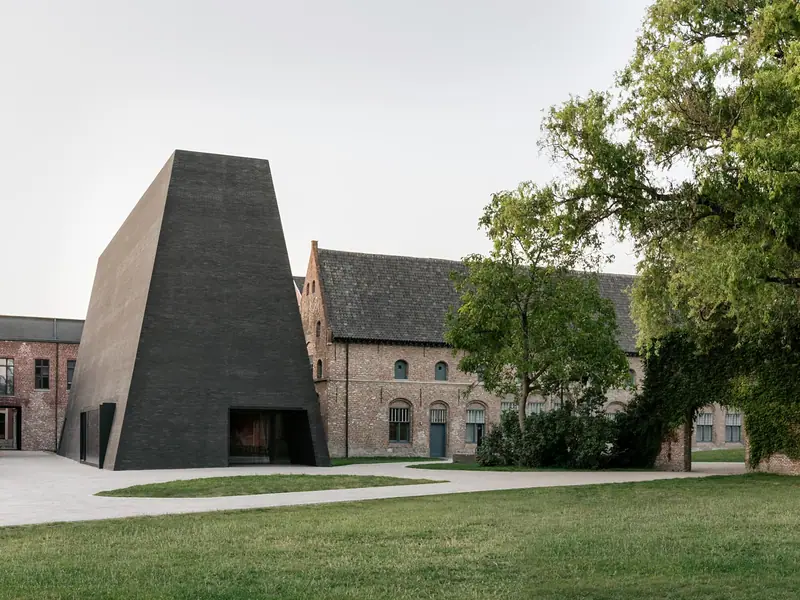
Estudio Barozzi Veiga is an architecture practice based in Barcelona, Spain, founded in 2004 by Fabrizio Barozzi and Alberto Veiga. Barozzi was born in Rovereto and Veiga in Santiago de Compostela. The practice designs concert halls, opera houses, cultural centres, museums, and galleries.
Its buildings are mostly public and cultural, with agricultural projects and refurbishments alongside them, and reinforced concrete, exposed brickwork, and stone cladding recur, often in white. The Ribera del Duero wine centre in Roa dates from 2010, the Infanta Doña Elena auditorium and congress palace in Águilas from 2011, and the Philharmonic in Szczecin from 2014.
At Chur, in the Swiss canton of Graubünden, the practice designed the extension to the Bündner Kunstmuseum as a separate building beside the landmarked Villa Planta. It is an 18-metre cube clad in precast concrete panels of 50 × 50 centimetres, with ornamental motifs developed for the project as a contemporary echo of the villa's decorative interior. Most galleries lie underground, reached through a five-metre-high foyer whose full-height west window frames the villa, and two exposed concrete stairwells connect the basement levels.
Upstairs, a project space called the Laboratory holds rotating artist residencies. Ceilings of layered fibreglass panels give the galleries soft LED light that approximates daylight, and a stairway links the building to the villa's underground cabinet. The doors carry FSB 1035 and 1031 lever handles with angular geometry and square roses.
Each project starts from a study of its place, and the partners shape their working method around what is specific to it.