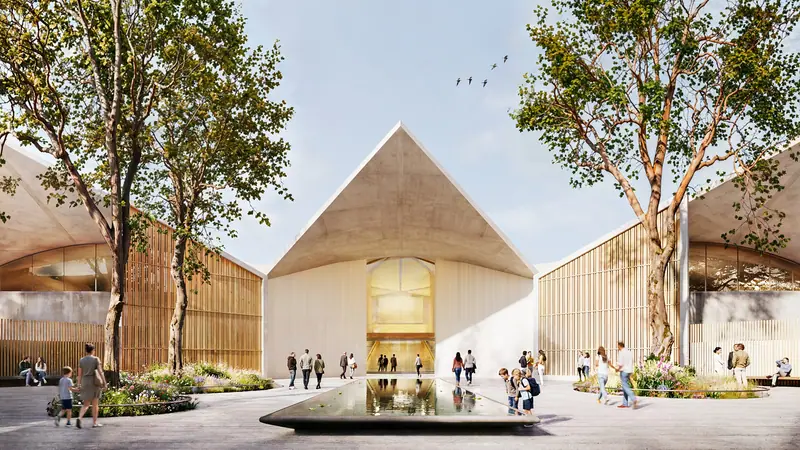
Herzog & de Meuron is an architecture practice based in Basel, Switzerland, founded in 1978 by Jacques Herzog and Pierre de Meuron. Both founders studied at ETH Zurich, the Swiss Federal Institute of Technology. The practice is based in Basel and designs buildings for culture, sport, housing, healthcare and cities.
The practice's fields run from art spaces and hospitals to life sciences, residential work, retail and hospitality, and urban and territorial planning. Sport is a field of its own, and the practice also designs interiors and objects as well as buildings. Design technologies and sustainability appear among its topics, next to cultural education and an academy. It also publishes monographs and writings and gives lectures and talks.
Early work in Switzerland includes the Ricola Storage Building in Laufen, which joins a working storage function to an artistic treatment, and the stone-clad Signal Box in Basel, where the practice experimented with materials. At Tate Modern in London, it turned a former power station into an art museum, keeping much of the original structure and adding modern elements.
The practice designed the National Stadium in Beijing, known as the Bird's Nest, around a lattice-like steel structure. In Weil am Rhein, Germany, it designed the VitraHaus, and in Duisburg, Germany, it extended the MKM Museum Küppersmühle. Both founders have held professorships at institutions including Harvard University.