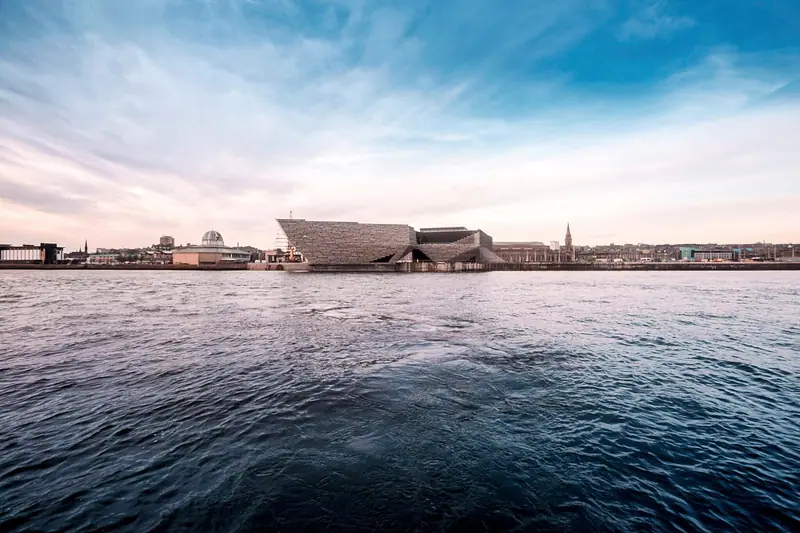
Kengo Kuma & Associates is an architecture and design practice based in Tokyo, founded in 1990 by the architect Kengo Kuma. It designs buildings, interiors and furniture, with further offices in Paris, Beijing, Shanghai and Seoul.
The practice works mainly in timber, bamboo, paper and stone, broken into slats, lattices, screens and louvres that repeat as small modular parts. Each building is shaped to blur the line between structure and setting, drawing on the regional materials, topography and local communities of its site, an idea Kuma set out in his book Anti-Object, first published in 2000.
Great (Bamboo) Wall in China is a private residence, a linear bamboo form that filters light along an undulating ridgeline, and it was the practice's first major overseas project, in 2002. The GC Prostho Museum Research Center in Kasugai, Aichi, takes its latticed façade from a traditional interlocking wooden toy, built as a three-dimensional grid that needs no nails or glue. In Tokyo, the Nezu Museum has bamboo walkways and clean lines, while Japan National Stadium has layered eaves and timber joinery. V&A Dundee takes its layered, horizontal form from Scottish cliffs and sits on the city's waterfront.
After Japan's bubble economy collapsed, the practice took on smaller projects across rural Japan, working with artisans and carpenters in traditional construction techniques. Before that it designed M2, a monumental structure for Mazda in Tokyo, in the final years of the bubble.
The studio's interiors and furniture follow the same approach. Rugs are made with Yamagata Dantsu and Jaipur Rugs, Kumashima textiles with the designer Noriko Tsuiki draw on a weaving tradition in southern Japan, and the curved Akane chairs are made from insect-eaten wood from Wakayama Prefecture.