Snøhetta is a transdisciplinary architecture practice based in Oslo, Norway, and founded in 1989. It works across architecture, landscape architecture, interior architecture, art and product design, often combining several in one project. The name comes from a mountain in central Norway.
Its first significant commission was Bibliotheca Alexandrina, which revived the ancient library in Alexandria, Egypt. The Norwegian National Opera and Ballet in Oslo and the National September 11 Memorial Museum Pavilion in New York City followed. At the other end of the scale, the practice has designed a bird nest, the Vulkan beehives, tables, chairs and the Flyt paver system.
Research runs through the work. The practice tests plastic, clay, wood and low-carbon concrete, and designs energy-positive buildings that return clean energy to offset their CO2 footprint over their lifetime, Powerhouse Brattørkaia among them. Forite is one of the environmentally sensitive construction materials it has developed, and it is made into tiles.
Regional studios run from Oslo to New York, Paris, Melbourne and Hong Kong. At the core of its design studios are modelling workshops with CNC robots, 3D rapid prototyping, woodworking equipment and hand tools, where prototyping is part of the design process. Outside people join projects through workshops, a method known as transpositioning. Offices are open and non-hierarchical, with staff of every role sitting together in one studio.
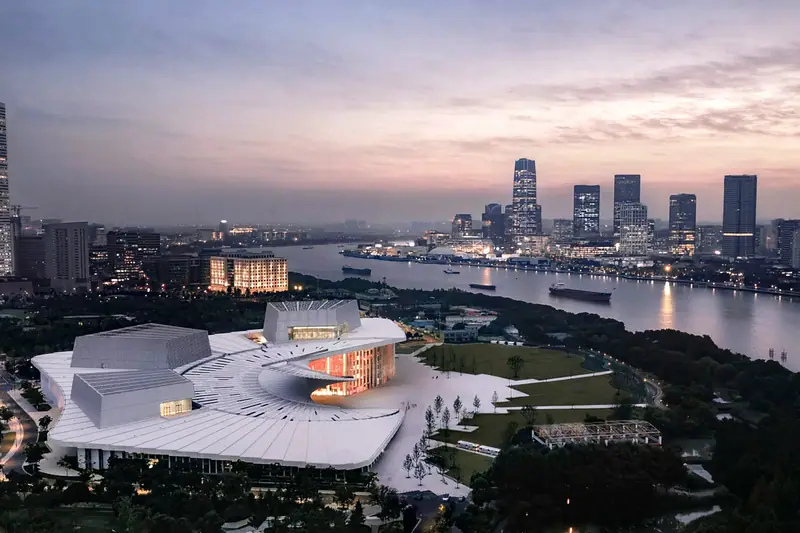
Shanghai Grand Opera House, on the Huangpu River, puts three auditoriums beneath a single roof, which is open as a stage and observation deck. Harmony Hall seats 2,000, Soar Theatre 1,200, and Open Stage 1,000 for experimental formats. Snøhetta Books, its publishing imprint, draws on the archive for titles such as Bibliotheca Alexandrina and Le Monde HQ Sketchbooks.